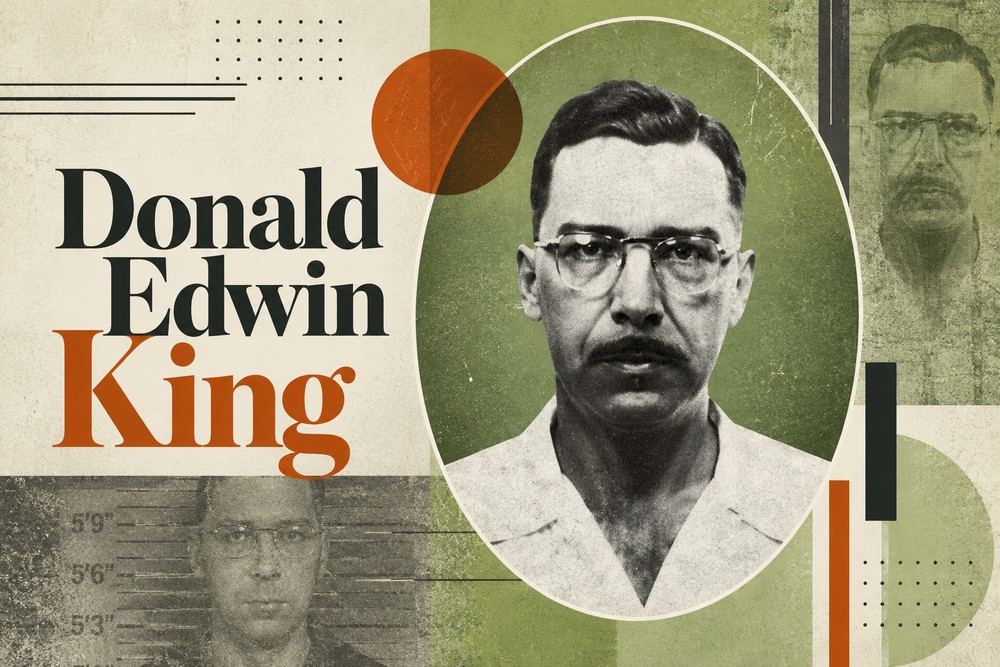
Early Life and a Name Reimagined
I picture a small house in Peru, Indiana, in the last years before the Roaring Twenties. A boy named Donald Edwin Pollock is born in 1914, then loses his father when he is just four. His mother, Helen, rebuilds as best she can, brings her children into a blended household, and tries to steady them in a world that does not pause for grief. By the time the 1930s take hold, the family is in Chicago, living the stop-and-start rhythm of working-class survival.
Somewhere between late adolescence and young adulthood, Donald sheds Pollock and takes the name King. The files are quiet about why. Debt, fresh start, assimilation, pride, shame, or maybe all of the above. I have learned that names can be armor. His choice seems less a flourish than a shield, the way some men change jobs or towns to outrun a ghost that rides shotgun no matter where they go.
Marriage to Ruth and the Arrival of Two Boys
In the summer of 1939, Donald marries a Maine woman named Nellie Ruth Pillsbury. They are young and hopeful, and the country is still months away from joining a war that will swallow so many American sons. He works on the water and on the road, a merchant seaman when ships need crews and a salesman when roads promise new territory. The war years arrive, and he serves as a U.S. Navy veteran during World War II, part of that vast logistical web that kept the Allied effort supplied and moving. Afterward, he returns to life in motion, the kind of work that makes the days blur.
They adopt a son, David, in 1945. Two years later, Ruth gives birth to Stephen in Portland, Maine. Despite the hardship, those first years look like the blueprint of postwar family life. A rented place, secondhand furniture, a little money coming in, a little more going out. Travelers at heart, or maybe just men without many options, often make poor stay-at-home husbands.
The Day He Did Not Come Back
Donald leaves to get cigarettes in 1949 and never returns. Simple and brutal, family lore maintains the detail. It’s obvious what occurred next. Ruth works harder. When rent rises or jobs disappear, she transfers her boys. She calculates necessity and annoying bills. Stephen uncovers a box of his father’s papers in an attic, the paper whispering that the elder King dreamed of writing. I imagine a sailor who loved words but couldn’t make a living from them, constantly ready to leave, even at supper.
That absence becomes a fulcrum. It tilts the family’s future and presses itself into the sons’ imaginations, especially the younger boy whose career will eventually tower over the American literary landscape. Loss has a way of tuning the ear to tension, and dread often traces back to a closed door that never opens again.
A Second Marriage and a Distant Later Life
After leaving his first family, Donald remarries. His second wife is Helen E. Costa. They have three sons together, named Garret, Roderick, and Donald C. The second household is quieter in the public record, a hum rather than a song. Donald works as a traveling salesman; he remains connected to the sea as a merchant seaman. If he carries the weight of what he left behind, the documents do not say.
He dies on November 8, 1980, in Easton, Pennsylvania, at 66. The obituary ink has long since faded, and no grand ledger of life’s riches survives, because there were none to record. Whatever balance sheet he kept lived in his own mind.
Parents, Sister, and the Early Household
Before any of this, there was the Pollock family of Indiana. Donald’s father, William, dies in 1918 during the era of the flu pandemic. His mother, Helen, raises Donald and his younger sister, Betty, then marries again to a man named Victor Szczepanski. The household moves to Chicago, where the blends of names, languages, and memories are common. The surname Pollock traces back to Irish roots in the generations before Donald, a reminder that American identity is often a tapestry stitched from many hands.
Betty remains a familiar anchor in the family’s story. She hosts relatives, helps during lean stretches, and represents the quiet labor of kinship that rarely makes headlines.
Children, Grandchildren, and the Long Reach of Family
From the first marriage come two boys, David and Stephen. David is adopted, then raised alongside his younger brother by a mother who keeps the family together with grit and low-wage caregiving work. Stephen, of course, becomes one of the most widely read authors of his time. He marries the writer Tabitha Spruce, and together they nurture a household where stories are not a luxury but the family business.
Through Stephen and Tabitha come three grandchildren for Donald, though he is long gone by the time they make their mark. Naomi is a writer and minister. Joe Hill, born Joseph Hillström King, becomes a notable author in his own right. Owen writes fiction and collaborates with his father. The line continues with great-grandchildren, including a boy named Ethan through Owen. The tree flourishes where the trunk once forked.
Work, Service, and the Limits of Achievement
If celebrity is a lighthouse, Donald’s life is a lantern on a back stoop. He serves in World War II, then takes on the hard miles of postwar sales. He works at sea and works on commission. You can almost hear the pitch at a doorway, the weight of a sample case in his hand. There is no public fortune to tally, no awards to catalog. He is not the protagonist of his own era. The closest he comes to a lasting record is the memory of a man who once tried to write, then stopped.
That said, modest is not meaningless. A civilian merchant seaman logging Atlantic crossings, a Navy veteran hauling what the war demands, a salesman trying to pay rent, a husband with a second start that sticks longer than the first. These are so many American stories, even when they vanish from the ledgers.
Names, Identity, and Reinvention
The change from Pollock to King is the hinge that gives this story its most mysterious swing. It feels like a small American epic in one detail. I find myself wondering what he wanted that the old name could not permit. Sometimes a name change is a kind of divorce from the past. Sometimes it is a pledge to a future the past would not allow. Either way, the choice becomes a signal that he was willing to be someone else if that was what it took to keep moving.
Absence and the Echo in Stephen’s Work
I have read enough of Stephen King to notice how frequently fathers vanish, or how often authority figures fail to protect or stay. The shadow of Donald’s departure shows up in emotion rather than citations. A wink of a name here, a man who does not return there, a seam in a character’s backstory where abandonment and resilience meet. Art does not need a court transcript. It needs a scar and a steady hand.
Timeline Highlights
Born in March 1914 in Indiana, father died in 1918, mother remarried by the 1930s, moved to Chicago, name changed to King in late teens and early 20s. Married in Maine in 1939, participated in WWII, raised two sons, and disappeared from the first family’s life in 1949. Remarried, had three additional boys, worked on the road and sea, died in Easton in 1980. In the 1990s, his first sons discovered his fate. A life’s footprints, some worn by time, some imprinted deep by decision.
FAQ
Who was Donald Edwin King?
Donald Edwin King, born Donald Edwin Pollock in 1914, was a World War II veteran, a merchant seaman, and a traveling salesman who became known to the public primarily as the estranged father of author Stephen King. He left his first family in 1949, later remarried, and died in 1980 in Easton, Pennsylvania.
Why did he change his name from Pollock to King?
There is no confirmed reason. He adopted the surname King sometime between late adolescence and his early twenties. Theories include a desire for reinvention, a break from complicated family dynamics, or the pursuit of a more assimilated identity in a period when names carried heavy social weight.
Did he serve in World War II?
Yes. He was a U.S. Navy veteran during World War II, and he worked as a merchant seaman. His contributions were part of the crucial, often overlooked backbone of wartime logistics and transport.
What happened to his first family after he left?
His first wife, Nellie Ruth, raised their sons, David and Stephen, on her own. She worked long hours in caregiving and moved when jobs or rents demanded it. The family lived with little money but with a surplus of tenacity. Stephen later spoke of the emotional impact of his father’s absence and discovered some of his father’s unpublished manuscripts.
Did he ever reconnect with his first family?
No. There is no record of reconciliation. Decades later, Stephen King hired a private investigator who determined that Donald had died in 1980, without having re-established contact.
Did he write, and was anything published?
He wrote, at least privately. His son Stephen found unpublished manuscripts among family possessions. There is no evidence that Donald ever published his work. The pages seem to mark an ambition rather than a career.
When and where did he die?
He died on November 8, 1980, in Easton, Pennsylvania, at the age of 66.
Who are his descendants?
From his first marriage came two sons, David and Stephen. Stephen and his wife, Tabitha, have three children who are adults and writers or public figures in their own right: Naomi, Joe Hill, and Owen. From his second marriage to Helen E. Costa came three sons named Garret, Roderick, and Donald C. The family now includes great-grandchildren, including a boy named Ethan through Owen.