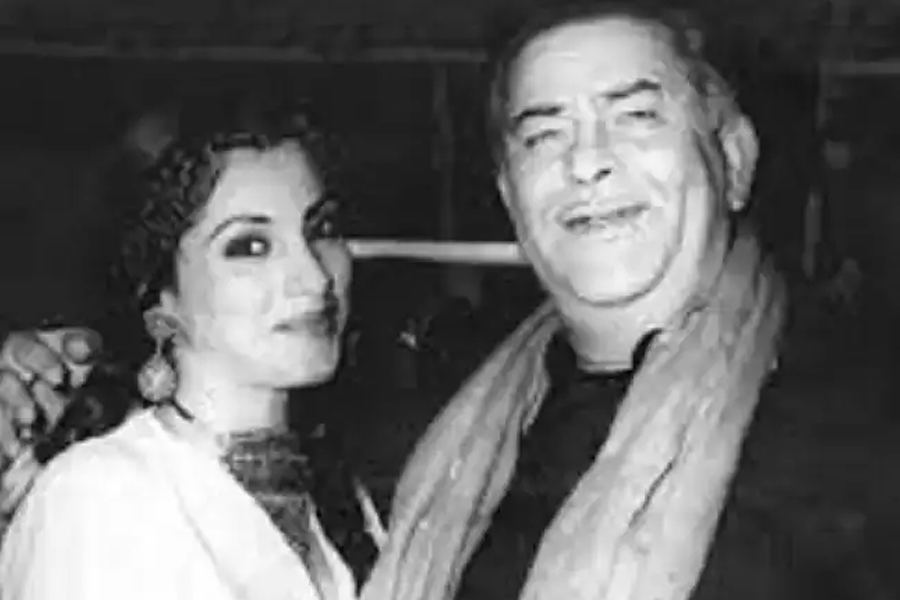
A name behind luminous screens
When people speak of the Kapadia name in Indian cinema, they often begin with a star and work backward. I prefer the opposite. I start with the quiet axis that held the wheel steady. Chunnibhai Kapadia appears in the public record not as a celebrity but as the Gujarati businessman whose home life became the staging ground for one of Bollywood’s most recognizable dynasties. He was the father of Dimple Kapadia, the husband of Betty Kapadia, and the patriarch whose presence is felt in the stories of his children, grandchildren, and great grandchildren. He is not the subject of filmographies or trade interviews. Yet without him the family narrative would read differently, its lines less anchored, its arcs less believable.
Roots and a household that formed a constellation
Chunnibhai is described in reputable profiles as a Gujarati businessman with social standing and a pragmatic eye. He married Betty Kapadia, known to family and friends as Bitti or Betty, who would go on to be referred to as the matriarch in later press mentions. Together they raised four children in Bombay, the city that would place the family on a famous map.
At the center stood Dimple, born in 1957, the eldest. Simple followed in 1958, then Reem in the years after, and a son known as Suhail or by the nickname Munna. The house was not a film set, yet it produced screen lives that would change the shape of popular culture. The cadence of their home life seems to echo in public profiles of Dimple and Simple, where warmth and strictness, aspiration and caution, sit side by side.
A marriage that shook the city and reshaped a lineage
When Dimple married Rajesh Khanna in 1973, the event sent a current through Bombay’s social circuit. The union joined a rising young actress to the reigning superstar, creating a bridge between the Kapadia household and the Hindi film establishment. From the perspective of a family biographer, this was not only a love story or a celebrity headline. It was a transformative hinge in the family’s public identity. Chunnibhai’s name began to appear as father of the bride, then as the father of a star who would leave films at her peak, return years later, and carve a career marked by striking choices.
The marriage would eventually yield two granddaughters for Chunnibhai, Twinkle and Rinke. They, too, entered films as young women, then moved into other public roles. Twinkle, in particular, developed a voice as an author and columnist, while Rinke chose a quieter public profile after a brief acting stint. Through them, the family tree extended into new branches, into another generation of public life.
Daughters who defined eras
Dimple’s life is well known. She entered cinema with a burst of light, then stepped away to build a home, then returned with a series of performances that made critics recalibrate how they spoke about screen presence. Her father appears in those narratives as the early anchor, the man whose standing and guidance framed the start of her journey.
Simple, her younger sister, followed a different arc. She acted in films in the late 1970s and 1980s, then reinvented herself as a costume designer. Her work behind the scenes was admired by colleagues who knew the rigor she brought to the craft. Simple’s death in 2009 after a battle with cancer left a clear ache in the family story. Yet the line does not end there. Her son, Karan Kapadia, stepped into acting, often speaking with gratitude about the aunt and mother who shaped him. In his voice you hear the echoes of a family that keeps pulling its own back to center.
Reem, the younger sister mentioned in family accounts, is the most elusive. Over time, reports have connected her death to sleeping medication or an overdose, with conflicting accounts. I handle those pieces carefully. They are part of family lore, although there is no consensus. Life was short, and her death changed the Kapadia home.
The quieter branch, sons and nephews
Suhail, often referred to as Munna, appears in public mentions as a more private figure. He is cited in stories involving family properties and occasional social notes, but he does not court the camera. Every large family has such a branch. It is the steady line that resists spectacle, the kind that grounds a narrative in ordinary days.
The nephew who surfaces most often is Karan, Simple’s son, who represents a next wave of onscreen Kapadias. Through him, the family continues to experiment with careers in the arts, sometimes stepping forward, sometimes retreating, always circling back to the same surname that carries both expectation and familiarity.
Matriarch Betty and the home circle
If Chunnibhai was the quiet axis, Betty was the domestic weather. She died in 2019, and the coverage of her passing emphasized her role as the family’s heart. In many public tributes the children’s faces told the story of grief and gratitude. When I picture the Kapadia home across decades, I see two figures shaping its everyday rhythm. One was Betty, the immediate sun. The other was Chunnibhai, the constant moonlight.
Wealth, work, and what the record does not say
Publicly, Chunnibhai is cited as a businessman and industrialist with Gujarati roots. That phrase repeats across biographies and profiles. Yet formal details are surprisingly sparse. No comprehensive ledger of company posts or a verified net worth appears in mainstream public records easily accessible today. He was not a press-facing executive or a regular guest at business conclaves documented with zeal. Instead, his visibility emerges through family moments, weddings, births, funerals, and the recollections of children who stepped into the public eye. For a man outside cinema, this is an unusual form of fame, almost like light reflected off a lake. You know the sun is there because the water glitters.
A family line that keeps widening
Through Dimple and Rajesh Khanna came Twinkle and Rinke. Twinkle married Akshay Kumar, and their children, Aarav and Nitara, appear in family photographs that circulate every few months. Rinke married into the Saran family and has kept a more private footprint. Across this branch, the Kapadia lineage moved from one era of Indian cinema to another, from the glamour of the 1970s to the multiplex blend of the 2000s and beyond. The family name became a quiet credential, a shorthand for a household that understands the push and pull of celebrity.
Anecdotes that keep the narrative alive
Family histories grow a few side stories of their own. In music circles, one well known singer has remarked in an interview that he shares a cousin link with Dimple’s father. It is an anecdote, a conversational seed that suggests a wider web of Kapadias spanning borders and professions. Whether such claims ever get a formal family chart is almost beside the point. They speak to how far the name travels, how it invites recognition in unexpected rooms.
A timeline in simple strokes
Start with Bombay in the mid 20th century and a family with Gujarati roots. Mark 1957 for the birth of Dimple, then 1958 for Simple. Add the early 1970s for Dimple’s discovery and 1973 for the marriage that became a citywide event. Move through the late 1970s and 1980s, when the younger sisters tested their luck on screen, and into the following decades as the family matured into a multigenerational public presence. Note the sorrow of Simple’s death in 2009 and the passing of Betty in 2019. Through it all, hold steady on the idea that Chunnibhai’s role remained primarily familial rather than institutional. He was the father, the husband, the constant in the background. That is the line that ties the whole together.
FAQ
Who was Chunnibhai Kapadia
He was a Gujarati businessman and the patriarch of the Kapadia family, best known publicly as the father of actress Dimple Kapadia and the husband of Betty Kapadia. His visibility comes from the lives of his children and grandchildren rather than a public career of his own.
What did he do for a living
He is described in public profiles as a businessman or industrialist. Specific company positions or a detailed business timeline are not widely documented in mainstream public records.
How is he connected to Rajesh Khanna
Chunnibhai became Rajesh Khanna’s father in law when Dimple Kapadia married the superstar in 1973. That marriage linked the Kapadia household to the most talked about star circuit of the era.
Who are his children
Chunnibhai and Betty had four children. Dimple Kapadia, the eldest, became a celebrated actress. Simple Kapadia acted and later became a costume designer. Reem Kapadia, a younger sister, is a less documented figure whose life ended tragically. Suhail, often called Munna, is a more private member of the family.
Who are his grandchildren and great grandchildren
Through Dimple came two granddaughters, Twinkle and Rinke. Through Simple came a grandson, Karan Kapadia. Twinkle’s children, Aarav and Nitara, are part of the next generation, and they appear occasionally in family photographs shared publicly.
Is there a clear public record of his net worth
No. There is no reliable, verified public estimate of Chunnibhai Kapadia’s net worth. He is not widely profiled in business media with audited figures or detailed filings in the public domain.
What is known about Reem Kapadia
Reem appears in family accounts as a younger sister of Dimple and Simple. Reports over the years have suggested that she died young, with some accounts mentioning sleeping pills or an overdose. These narratives vary and should be treated as unconfirmed details rather than established fact.
Did his family background help launch Dimple’s career
Biographical profiles often note that family standing and early support shaped Dimple’s path to a screen test and debut. While talent and timing made her a phenomenon, the family’s anchoring role is frequently acknowledged.
Is there a wider Kapadia clan connection beyond India
Anecdotes in interviews have mentioned a cousin link between Dimple’s side of the family and a prominent musician. Such claims remain conversational and are best viewed as family lore unless a formal genealogy is shared.
When did Chunnibhai Kapadia pass away
Public references indicate that he had passed away by the time later family milestones were reported. A detailed obituary with date and circumstances is not widely available in major public archives, so the specifics remain unclear.