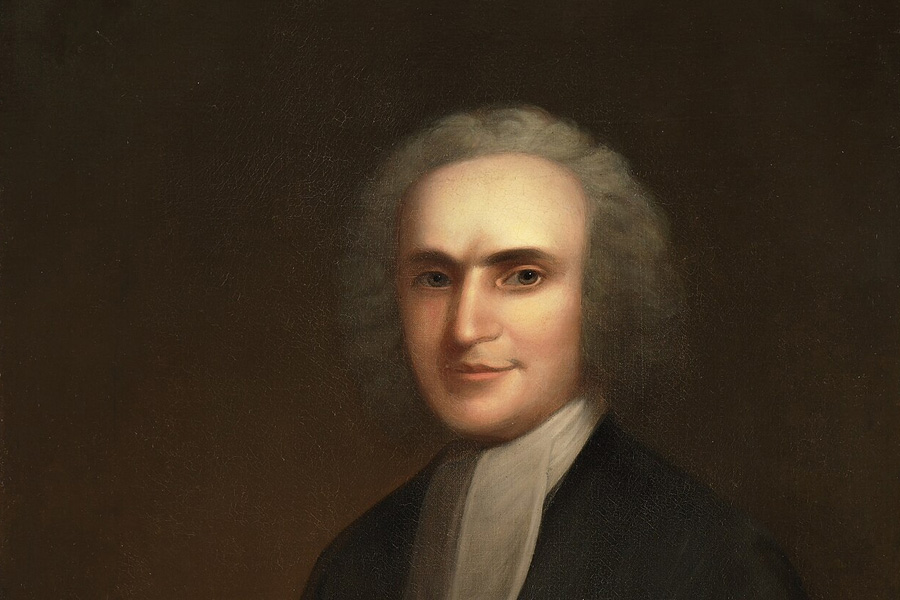
Early Life and Education
When I picture Aaron Burr Sr., I see a young scholar climbing the worn steps of Yale College with a head full of scripture and Greek declensions. He was born on January 4, 1716, in Fairfield, in the Connecticut Colony, where Puritan habits met the rhythms of a prosperous farm. His father, Daniel Burr, was a well-off landholder, and his mother, Elizabeth Pinkney Burr, gave him both affection and a sense of steadiness. The family was extensive. Through Daniel Burr’s multiple marriages, Aaron had older half siblings such as Hannah and Jehu, names that speak of a world steeped in scripture and English colonial grit.
By 1735, Burr stood at the top of his Yale class. That distinction mattered. It signaled not just intellectual talent but also moral promise in a culture that blended the two. He lingered in New Haven for theological study, sharpening his Latin and Hebrew alongside divinity. Those years planted in him a style I admire: lucid, orderly, and evangelical without being shrill.
Ministry in Newark and the Great Awakening
Licensed to preach in 1738, Burr accepted a call to the Presbyterian Church in Newark, New Jersey. He preached, taught, and, crucially, opened a classical school, aiming to prepare youth for both ministry and learned professions. This was the age of the Great Awakening, when sermons could spark spiritual brushfires. Burr stood with the so-called New Lights, who championed heartfelt conversion, vibrant preaching, and reform within Presbyterianism. That stance brought criticism from Old Light authorities, especially in the academic world. He weathered the controversy with a calm conviction that faith and learning need not be adversaries.
I imagine his pulpit like a compass, pointing congregants toward an evangelical piety that also valued order. Even as he preached revival, he kept a mind for curriculum and discipline. In Burr’s hands, revival was not merely a wildfire. It was a forge.
Founding a College
The conflict between revivalist and traditionalist camps set the stage for a bold experiment. Alongside allies such as Jonathan Dickinson and the formidable theologian Jonathan Edwards, Burr helped establish the College of New Jersey in 1746. At first, classes met in Elizabeth. After Dickinson’s death, Burr became the college’s second president in 1748, with the approval of Governor Jonathan Belcher. He was 32, full of energy, and uniquely suited to build the new school’s bones.
What did he build? A set of entrance requirements that demanded real preparation, a curriculum that yoked classical languages to moral philosophy, and a system of regulations that shaped character as surely as intellect. Enrollment rose from a handful of students to more than forty within a few years. Burr presided over the first commencement in 1748, sending forth graduates such as Richard Stockton, who would make a mark on the new nation. For a time he served without a salary, which tells you both about the college’s shoestring beginnings and his commitment to the cause.
In 1756, he oversaw the move to Princeton and the completion of Nassau Hall. At that time, Nassau Hall was the largest building in the colonies, its thick stone walls standing like a manifesto in architecture. Burr had practiced administration as a moral art. Now he practiced it as masonry.
Marriage to Esther Edwards and the Household World
Another union defined his life. In 1752, Burr married Esther Edwards, daughter of Jonathan and Sarah Edwards. Through this marriage, two potent strains flowed together: the brisk administrative talent of Burr and the theological intensity of the Edwards family. Esther was a writer and observer of extraordinary sensitivity. Her letters and journal reveal a mind attuned to friendship, faith, and the daily liturgies of a minister’s household.
They had two children. Sarah, known as Sally, was born in 1754 and later married Tapping Reeve, a legal educator who founded the Litchfield Law School. In 1756, Aaron Burr Jr. entered the world, destined to blaze across American politics with a controversial brilliance. I like to picture the family table in Newark and then Princeton, a small circle lit by candlelight, where scripture, scholarship, and practical matters shared the same bread and conversation.
Children, Descendants, and the Tangled Family Tree
Burr Sr.’s influence radiated not only through the college but through his descendants. Sally would become the quiet matriarchal link between the Burr and Reeve households, an example of the way learned women shaped early American life. Aaron Jr. became the third vice president of the United States, a soldier of the Revolution and a lawyer of note, remembered for the duel with Alexander Hamilton and for tangled later years.
Grandchildren came primarily through Aaron Jr. Theodosia Burr Alston stands out, famed for her intellect and tragic disappearance at sea. Another often-named grandson is John Pierre Burr, remembered as an abolitionist. There were others associated with the family orbit, including Aaron Columbus Burr through adoption. The web of Burr descendants reaches into American law, politics, and reform movements. It also touches the lived contradictions of a new nation that prized liberty while struggling with slavery and status.
When I trace these lines, I see the way one minister’s life sent out currents across centuries. The family network included not only Burrs, but Edwards kin, colonial magistrates, and jurists. Their stories fold into the larger tapestry of the colonies becoming a republic.
Slavery, Wealth, and the Difficult Ledger
Burr Sr.’s world was not free of the moral compromises of his age. Records indicate he owned enslaved people, noted in his will with valuations that convert human lives into currency. His estate suggests modest prosperity by colonial standards, rooted in family land and clerical income rather than great riches. Yet the presence of slavery in his household and in Princeton more broadly is a sober reminder. Institutions we admire bear marks that require honesty and lament. If Burr gave the college its structure, we must remember that the world in which he labored was one where bondage stood alongside books.
Final Years and Enduring Imprint
By 1755, Burr was relieved of his Newark pastoral duties so he could devote himself fully to the college. The next two years were a sprint. The move to Princeton, the oversight of Nassau Hall, the rise of enrollment, and the demands of a young family all converged. On September 24, 1757, just as the Edwards family was pressing into Princeton’s orbit, Burr died at age 41, likely from exhaustion or fever. He was buried in Princeton Cemetery. Jonathan Edwards succeeded him briefly, then the presidency passed to others, but Burr’s framework endured.
When I walk past Nassau Hall in my imagination, I still hear his cadence. Clear, evangelical, exacting. He was a builder, not of cathedrals, but of minds.
FAQ
Who were Aaron Burr Sr.’s parents?
Aaron Burr Sr. was the son of Daniel Burr, a prosperous farmer in Fairfield, and Elizabeth Pinkney Burr. Through his father’s prior marriages, he had several older half siblings, which placed him within a large and well-connected colonial family.
How did Aaron Burr Sr. help found the College of New Jersey?
He was part of the evangelical coalition that launched the College of New Jersey in 1746. After Jonathan Dickinson’s death, Burr became the president in 1748 and shaped the institution’s curriculum, entrance requirements, and governance. He supervised the move to Princeton and the construction of Nassau Hall, setting the college on a stable academic footing.
Whom did he marry, and how did that shape his legacy?
He married Esther Edwards, daughter of Jonathan and Sarah, in 1752. Burr married into a prominent ecclesiastical family. Esther’s writing shows their household and Burr’s blend of scholarship and devotion.
Did Aaron Burr Sr. own enslaved people?
Yes. Records of his estate indicate he owned enslaved people, with valuations listed in his will. This fact places him within the painful realities of colonial society and reminds us that the origins of American higher education are entangled with slavery.
What happened to his children after his death?
Burr died in 1757, and Esther died in 1758. Their children, Sarah and Aaron Jr., were left orphans and were raised by relatives within the Edwards family network. They both went on to lives of public significance, each in different ways.
Who were some notable descendants?
Theodosia Burr Alston, the learned and tragic daughter of Aaron Jr., is perhaps the most famous. John Pierre Burr is often identified as a grandson and is remembered for abolitionist work. The family line touched law, politics, education, and reform movements in the early republic.
How large was Nassau Hall and why did it matter?
When completed in 1756, Nassau Hall was the largest building in the colonies. More than a landmark, it symbolized the ambitions of the College of New Jersey. It housed classrooms, a library, and ceremonial spaces, and it helped secure the college’s permanence.
Was he controversial in his time?
Burr’s New Light alignment during the Great Awakening placed him at odds with Old Light authorities. While not scandalous in a personal sense, his evangelical commitments drew debate in ecclesiastical and academic circles. He navigated these disputes with a steady administrative hand.
How young was he as Princeton president?
He became president in 1748 at age 32. That made him among the youngest to lead the institution. His youth, paired with strong organizational talent, gave the college a dynamic start that shaped its character for generations.