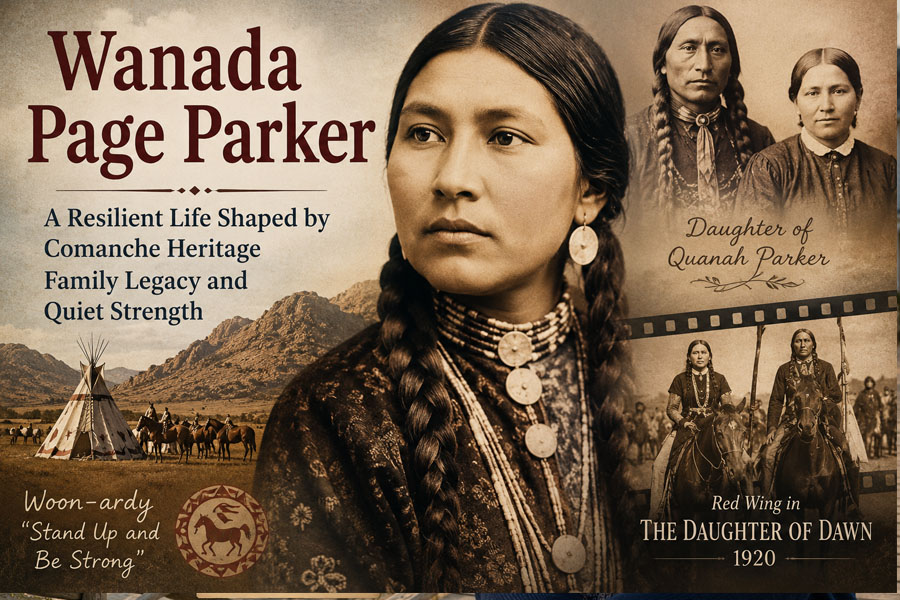
Basic Information
| Category | Details |
|---|---|
| Full Name | Wanada Page Parker |
| Other Names | Wanada Woon-ardy, Woonardy, Annie Parker |
| Comanche Name | Woon-ardy, meaning “Stand Up and Be Strong” |
| Born | About 1882 or 1887 |
| Birthplace | Indian Territory, present day Oklahoma |
| Died | October 26, 1970 or 1971 |
| Place of Death | Lawton, Oklahoma |
| Parents | Quanah Parker and Weckeah |
| Grandparents | Peta Nocona and Cynthia Ann Parker |
| First Husband | Walter Komah |
| Second Husband | Benjamin Harrison Page |
| Occupations | Nurse’s aide, assistant matron, actress |
| Notable Film | The Daughter of Dawn |
| Film Role | Red Wing |
| Burial | Highland Cemetery, Lawton, Oklahoma |
Wanada Page Parker lived at the crossroads of several worlds. She was the daughter of Quanah Parker, one of the most recognizable Comanche leaders of the late nineteenth and early twentieth centuries, yet her own story is much quieter than his. Her life was shaped by family, education, work, faith, cultural memory, and an extraordinary determination that was captured in her Comanche name, Woon-ardy, meaning “Stand Up and Be Strong.”
When I look at Wanada’s story, that name feels almost like a blueprint for her entire life. She faced physical difficulties as a child, spent years in schools far from home, worked in Indian education and healthcare, appeared in a remarkable silent film, helped preserve her family’s history, and became an important bridge between different branches of the Parker family.
Growing Up in the Quanah Parker Family
Wanada was born in Indian Territory, now part of Oklahoma, around 1882 or 1887. Historical records disagree about her exact birth year, a common problem in records concerning Native American families of the period.
Her father was Quanah Parker, the famous Comanche leader whose life represented a dramatic transition in Comanche history. Quanah was the son of Peta Nocona, a respected Comanche war leader, and Cynthia Ann Parker, a white child who had been captured during the 1836 Fort Parker raid in Texas and eventually became deeply integrated into Comanche society.
Wanada’s mother was Weckeah, also recorded as Weck-E-Ah or Weakeah. She was the daughter of the Comanche subchief Yellow Bear. Through her parents, Wanada inherited connections to both powerful Comanche leadership and the complicated Parker family history that stretched across Comanche and white American communities.
Quanah had several wives and a large family. Estimates commonly place the number of his children somewhere around 22 to 25, although family lists differ. Wanada therefore grew up surrounded by a broad network of siblings and half-siblings.
Among those connected to her family were Cynthia Ann Nau-Nocca Parker, We-Rah-Re, Mary Pbutsi Parker, and Alice Tope-Se-Up Parker Purdy. Her half-siblings included White Parker, Tom Parker, Harold Parker, and Neda Parker Birdsong.
White Parker would later become especially important to Wanada’s story because the two siblings appeared together in The Daughter of Dawn.
The Meaning Behind Woon-ardy
One of the most memorable details of Wanada’s childhood was the physical weakness she experienced in her limbs.
As a young girl, she reportedly relied on crutches for a considerable period. Her Comanche name, Woon-ardy or Woonardy, was associated with the idea “Stand Up and Be Strong.”
It is difficult not to see the symbolism in that name. What began as a description of a child struggling physically eventually became an almost perfect reflection of the woman she became.
At Carlisle Indian School in Pennsylvania, her name was initially recorded as “Juanada.” She disliked the sound of the name because it seemed Spanish or Mexican to her. In 1895, she was baptized Annie at St. John’s Episcopal Church in Carlisle. Even so, Annie never became the name by which she was most commonly remembered.
Her family and cultural identity remained closely tied to her Comanche name and the Parker family.
Education Far From Home
Wanada’s education took her to various institutions.
She attended Chilocco Indian School before enrolling at Carlisle Indian School in Pennsylvania in 1894. Carlisle was thousands of miles from the Oklahoma terrain she knew, and her attendance at the college placed her within a larger federal Indian education system that tried to transform Native children in accordance with government policies of the time.
She attended Carlisle for numerous years with family members such as Harold and Neda Parker.
She also attended Fort Sill Indian School for almost a year, beginning in 1903. Her later job would take her back to the world of Indian education, but this time as a worker rather than a student.
That transformation is one of the most intriguing aspects of her biography. Wanada transitioned from receiving an education in these institutions to assisting in the care of those who reside there.
A Career in Education and Healthcare
Wanada worked as an assistant matron at Fort Sill Indian School. Her position placed her in a practical role involving the care and supervision of students.
Later, in 1915, she began working as a nurse’s aide at Fort Sill Indian Hospital.
This was more than simply a job. Healthcare work required patience, discipline, and daily contact with people who needed assistance. It was also at the hospital that she met the man who would become her second husband, Benjamin Harrison Page.
Wanada’s working life provides a fascinating contrast with the public image of her father. Quanah became known for ranching, business, politics, travel, and friendships with prominent Americans. Wanada’s world was more intimate. Her influence was often expressed through service, family relationships, and community connections.
Marriage to Walter Komah
Wanada first married Walter Komah, a Comanche man, around 1906 or 1908.
The couple eventually lived in Mescalero, New Mexico. Their marriage was short-lived because Walter died from tuberculosis in 1912.
After his death, Wanada returned to Lawton. She continued working and became increasingly connected to Fort Sill and the Parker family community.
The loss of her first husband was another major turning point. Within a few years, she would begin a second chapter of her life with Benjamin Harrison Page.
Meeting Benjamin Harrison Page
Wanada met Sgt. Benjamin Harrison Page while working at Fort Sill Indian Hospital.
Their courtship reportedly included rides on the streetcar, an everyday detail that gives the story a surprisingly cinematic quality. In December 1916, they married in the Fort Sill and Comanche County area.
Harrison was a white U.S. Army Medical Corps soldier. He was discharged on medical disability in 1917, shortly after their marriage.
The couple remained together for decades.
Harrison later became a chiropractor and began practicing in Apache, Oklahoma, around 1924. The couple also spent several years in Phoenix, Arizona, where Harrison attended C. H. Cook’s Bible School between 1929 and 1933. During that period, they also spent time at a Yaqui village.
They returned to Oklahoma in 1934 and eventually settled permanently in Lawton in 1938.
Wanada Parker and The Daughter of Dawn
Perhaps the most surprising chapter in Wanada’s life came when she became an actress.
Around 1919 and 1920, she appeared in The Daughter of Dawn, a silent Western filmed in the Wichita Mountains of southwest Oklahoma.
Wanada played Red Wing.
Her half-brother White Parker played White Eagle.
The production was extraordinary for its time because it featured an almost entirely Native American cast, with more than 300 Comanche and Kiowa performers participating. Rather than simply placing Native characters around white actors, the production put Native performers at the center of the story.
The film included dances, buffalo hunts, village scenes, horses, tipis, clothing, combat, and a romantic rivalry. The landscape itself became part of the film’s visual language.
For Wanada, acting was only one chapter in a much larger life. Yet it left behind something remarkable: moving images of her and members of her community from more than a century ago.
The Film That Nearly Disappeared
The Daughter of Dawn was largely forgotten after its early screenings.
For decades, the film was considered lost. Then, around 2004 or 2005, several cans of nitrate film were unexpectedly discovered in North Carolina.
The reels eventually reached the Oklahoma Historical Society, where archivists realized they had something extraordinary.
The film was fragile and incomplete in appearance. Nitrate deterioration had damaged parts of the material, while missing or truncated intertitles complicated the restoration.
Archivists reconstructed portions using surviving scripts and related materials. Preservation work included 35mm film work and later digital scanning. Original tinting was restored where possible.
A new orchestral score was composed by Comanche composer David Yeagley and performed by musicians associated with Oklahoma City University.
The restored film premiered publicly in Oklahoma City in June 2012.
In 2013, the Library of Congress selected The Daughter of Dawn for the National Film Registry.
That rediscovery transformed Wanada’s brief acting career into an important part of American film history and Native cultural history.
The Parker Family Legacy
Wanada’s importance extended beyond her on-screen appearance.
She became an enthusiastic preserver of Parker family memory.
In 1953, she assisted in organizing the first united Parker family reunion at Old Fort Parker, Texas. The meeting brought together descendants from both the Comanche and white branches of the family.
A especially meaningful friendship made the reunion possible. Wanada had a close relationship with Elsie Hamill, a Texas educator who was interested in the Parker family history. Their correspondence and collaborative efforts managed to bring families together.
The reunion became an annual and then biannual event.
Wanada was doing what her father had done, but in a completely different way. Quanah Parker spent most of his later life straddling two cultural worlds. Wanada also served as a link between family branches separated by Texas’ complex history, Comanche life, incarceration, assimilation, and reservation-era America.
Remembering Quanah Parker
Wanada also carried a special role in honoring her father.
In 1957, Quanah Parker and his mother, Cynthia Ann Parker, were reburied at Fort Sill Post Cemetery after being moved from Post Oak Mission Cemetery near Cache.
Wanada was designated by the family to receive the burial flag as the senior participating child.
Two years later, in 1959, she represented the Quanah Parker family at the unveiling of a sculptured bust of her father in Quanah, Texas.
In 1965, she was the only child of Quanah to travel to Texas for the removal and reburial of Prairie Flower, also known as Topsannah, Cynthia Ann Parker’s daughter and Wanada’s aunt.
Wanada later helped raise funds for a half-size monument honoring Prairie Flower. The monument was unveiled on July 18, 1970. By then Wanada was too ill to attend, so her sister Alice represented her.
These moments reveal another side of her personality. She was not simply remembering history. She was actively protecting it.
Her Final Years in Lawton
Wanada and Harrison eventually lived at 2313 I Street in Lawton.
Harrison worked as a painter and contractor after returning to Oklahoma, eventually retiring in 1956. In later years, Wanada and Harrison received care from their niece Theresa, Mrs. Albert Tahsequah, and her family.
Around 1970, the couple moved to Orlando Nursing Home.
Wanada died at the U.S. Public Health Service Lawton Indian Hospital on October 26, with records differing over whether the year was 1970 or 1971. Her detailed obituary gives 1971, while other records and her headstone give 1970.
She was buried in the Indian Section of Highland Cemetery in Lawton.
At the time of her death, she was remembered as the last surviving daughter of Quanah Parker, although her half-brother Tom Parker was still living.
Wanada and the Family Members Around Her
| Family Member | Relationship to Wanada | Significance |
|---|---|---|
| Quanah Parker | Father | Influential Comanche leader and rancher |
| Weckeah | Mother | Daughter of Comanche subchief Yellow Bear |
| Peta Nocona | Grandfather | Comanche war leader |
| Cynthia Ann Parker | Grandmother | Captive who became part of Comanche society |
| White Parker | Half-brother | Actor who appeared in The Daughter of Dawn |
| Alice Tope-Se-Up Parker Purdy | Sister | Family representative during later commemorations |
| Cynthia Ann Nau-Nocca Parker | Sister | One of Wanada’s close family connections |
| Walter Komah | First husband | Comanche husband who died in 1912 |
| Benjamin Harrison Page | Second husband | Army Medical Corps veteran and later chiropractor |
| Prairie Flower | Aunt | Daughter of Cynthia Ann Parker and Peta Nocona |
| Elsie Hamill | Close friend | Helped Wanada preserve and connect Parker family history |
A Life Between Memory and Modernity
Wanada Page Parker’s life feels like a thread that connects numerous chapters of American history.
She was born into a Comanche family during a time of great transition. She attended government Indian schools, worked in an Indian hospital, married across tribal boundaries, appeared in one of the few surviving all-Native silent films, lived in Arizona, returned to Oklahoma, and dedicated her latter years to preserving her family’s memory.
Her anecdote also reminds me that historical significance does not necessarily go to the loudest person in the room.
Quanah Parker got renowned.
Wanada became a goalkeeper.
She documented relationships, recollections, family ceremonies, and cultural connections. Her involvement in Parker reunions and commemorations guaranteed that the story did not end with the generation that lived through the eighteenth century.
And somewhere inside the restored frames of The Daughter of Dawn, there is Wanada herself, preserved in motion, riding across the screen as Redwing. The woman who used crutches as a child eventually became a part of film history, surviving when countless other silent pictures died.
Her Comanche name simply stated: Stand Up and Be Strong.
FAQ
Who was Wanada Page Parker?
Wanada Page Parker was a Comanche woman, daughter of Quanah Parker and Weckeah. She worked as an assistant matron and nurse’s aide and appeared as Red Wing in the silent film The Daughter of Dawn.
What did Wanada Parker’s Comanche name mean?
Her name Woon-ardy or Woonardy meant “Stand Up and Be Strong.” The name was associated with the physical difficulties she experienced as a child.
Who was Wanada Parker’s father?
Her father was Quanah Parker, the prominent Comanche leader who became a rancher, businessman, and advocate for his people after the transition to reservation life.
Who was Wanada Parker’s mother?
Her mother was Weckeah, also recorded as Weck-E-Ah or Weakeah. She was the daughter of the Comanche subchief Yellow Bear.
Was Wanada Parker related to Cynthia Ann Parker?
Yes. Cynthia Ann Parker was Wanada’s paternal grandmother. Cynthia Ann was the mother of Quanah Parker, making Wanada her granddaughter.
What movie did Wanada Parker appear in?
Wanada appeared as Red Wing in The Daughter of Dawn, a silent Western filmed in Oklahoma around 1920 with a predominantly Comanche and Kiowa cast.
Did Wanada Parker act with her brother?
Yes. Her half-brother White Parker appeared in the same film as White Eagle. Their participation makes the film especially significant within the history of the Parker family.
When was The Daughter of Dawn rediscovered?
Several nitrate reels were discovered around 2004 or 2005. The film was subsequently preserved and restored, eventually receiving a modern public premiere in 2012.
Did Wanada Parker have children?
Detailed biographical accounts do not identify any children of her own. In her later years, she was cared for by her niece Theresa Tahsequah and her family.
When did Wanada Parker die?
Records disagree on the year. Some list October 26, 1970, while a detailed obituary gives October 26, 1971. She died in Lawton, Oklahoma, at the Lawton Indian Hospital.
Where is Wanada Parker buried?
She is buried in the Indian Section of Highland Cemetery in Lawton, Oklahoma.
What role did Wanada Parker play in the Parker family reunions?
Wanada helped organize the first combined Parker family reunion at Old Fort Parker in Texas in 1953. The gathering connected descendants from the Comanche and white branches of the Parker family and developed into a continuing tradition.
Why is Wanada Parker historically important?
Wanada’s importance comes from several parts of her life. She was a member of the Quanah Parker family, worked in education and healthcare, appeared in a rare all-Native silent film, and became an important keeper of Parker family history and commemorative traditions.