A Puerto Rican Childhood in New York City
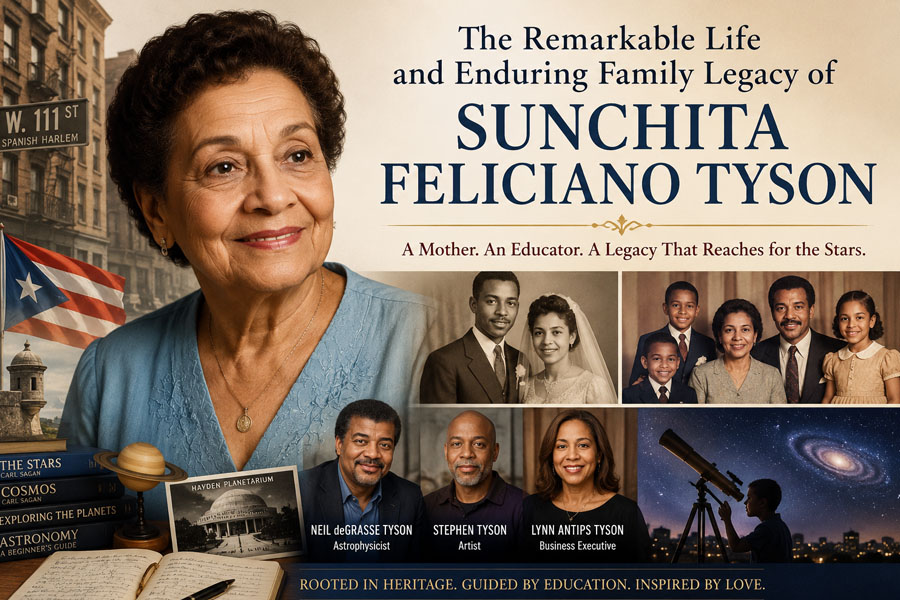
Sunchita Maria “Toni” Feliciano Tyson was born in 1928, with records varying between November 22 and November 28. She became known publicly as the mother of astrophysicist and science communicator Neil deGrasse Tyson, but her own life was a remarkable story of resilience, education, family devotion, and professional achievement.
Sunchita was a first generation mainland born Puerto Rican whose parents came from Arecibo, Puerto Rico. She lost both parents when she was only about four years old. Without the opportunity to grow up under their direct care, she was raised in New York City by two aunts who also had roots in Arecibo.
Her childhood unfolded primarily in Spanish Harlem and East Harlem during the difficult years of the 1930s. She later remembered growing up poor, although she did not necessarily understand the full meaning of poverty as a child. There was no television constantly presenting images of how other families lived, so comparison was limited.
English was another early challenge. Sunchita spoke limited English before entering public school and gradually became comfortable with the language. She also learned by listening to the radio, absorbing sounds and expressions from the world around her. Her distinctive name, Sunchita Feliciano, sometimes made her feel different among children with more familiar American names.
She remembered having long black hair and a widow’s peak, details that became part of the vivid personal portrait she shared decades later. Her childhood gave her an early lesson that would remain important throughout her life: identity could be both a source of difference and a source of strength.
Meeting Cyril deGrasse Tyson Again
Sunchita’s family story became intertwined with another New York family when she met Cyril deGrasse Tyson. The two had known each other as children while living in the same Harlem tenement, associated with 217 West 111th Street.
Cyril’s family eventually moved away when he was around 11 or 12. Years passed before their paths crossed again. When Sunchita was approximately 20 or 21, a mutual friend named Evelyn King helped reconnect them.
The childhood acquaintance gradually became a romantic relationship, and in 1952 Sunchita and Cyril married. Their marriage lasted 64 years, creating the foundation for a family whose influence would eventually reach far beyond New York City.
Cyril was an accomplished man in his own right. He was an African American sociologist, educator, civil rights activist, athlete, and public servant. His work included directing Harlem Youth Opportunities Unlimited, known as HARYOU, serving as a human resources commissioner under Mayor John Lindsay, and participating in antipoverty initiatives in New York and Newark.
Cyril’s family background also contributed to the children’s heritage. His parents, Albert Romig Tyson and Altima de Grasse, came from Nevis. Neil’s middle name, deGrasse, came from his paternal grandmother.
Building a Family in the Bronx and Riverdale
Sunchita and Cyril brought up three children in a Catholic home: Stephen Joseph Tyson, Neil deGrasse Tyson, and Lynn Antipas Tyson.
Their early family life revolved on New York City’s Bronx, specifically the Castle Hill neighborhood and its middle-income housing developments. Later, the family relocated to Riverdale. Their house was more than just a place where children ate, slept, and did their homework. It became a launching place for curiosity.
Sunchita and Cyril saw New York City as a kind of educational experiment. Museums, libraries, bookstores, parks, and cultural institutions became extensions of the children’s educational experiences.
Each youngster was encouraged to develop their own hobbies. One child was drawn to art, another to horses, and Neil to science. Rather than forcing their children onto a single route, Sunchita and Cyril gave structure while allowing curiosity to guide them.
That approach necessitated practical effort. The family sought bookstores for low-cost science literature and encouraged Neil’s hands-on experiments. When telescope equipment needed to be moved to the roof, family members assisted in carrying it upstairs.
Lynn later referred to herself as Neil’s “Sherpa” throughout some of his early scientific expeditions. That fun depiction describes the family dynamic perfectly. Neil’s curiosity with the universe was his own, but his family assisted him in pursuing it.
Sunchita Tyson as a Mother
Sunchita’s parenting philosophy was grounded in education, resilience, discipline, and independence. She understood that her children, who were brown skinned, would sometimes encounter prejudice or assumptions based on appearance.
Rather than allowing fear to dominate their upbringing, she taught them to be prepared and capable. Safety mattered, especially because three children were traveling through New York City and navigating a large urban environment.
Her parenting was practical rather than theatrical. She believed children should pursue their interests while understanding the importance of responsibility and education.
Her influence on Neil was particularly profound. She supported his early fascination with astronomy, accompanied him through experiences connected with the Hayden Planetarium, and encouraged his scientific curiosity.
Neil’s childhood included a fascination with Saturn, experiments involving a darkroom in the bathroom, and a growing desire to understand the night sky. Behind those memories stood parents willing to invest time, patience, and money in a child’s unusual interests.
For me, one of the most striking aspects of Sunchita’s story is that she did not need to be a scientist herself to help raise one. She understood something essential about education: sometimes the most important gift is giving curiosity enough room to grow.
Returning to Education as an Adult
Sunchita initially devoted herself primarily to homemaking. She and Cyril had agreed that she would focus on raising their children and caring for an older relative who lived with the family.
Her educational journey did not end there.
After her oldest son, Stephen, left for college, Sunchita returned to school as an adult. She earned an undergraduate degree at Fordham University, where she also worked, and later obtained a master’s degree in gerontology from Columbia University.
Her decision to return to education demonstrated a determination that had been present since childhood. She had already learned English as a young girl, navigated poverty and cultural differences, raised three children, and supported a household. Now she embarked on a new academic chapter.
Gerontology examines aging from multiple perspectives, including social, psychological, cultural, cognitive, and biological dimensions. Sunchita turned that education into a professional career serving older Americans.
A Career Serving Older Americans
Sunchita worked as a gerontologist in federal service, associated with the U.S. Department of Health, Education and Welfare and later government structures connected with health and human services.
Her work included directing programs for elderly people in Queens. Rather than pursuing public celebrity, she built a professional life around service to aging populations.
Her career is especially notable because it followed years devoted to raising a family. She demonstrated that motherhood and professional development did not have to be mutually exclusive stages forever. When circumstances changed, she returned to education and built another chapter.
She eventually retired from federal service.
There are few widely documented awards or published works associated with her career, but her professional contribution can be understood through the people and communities served by programs for older adults.
Stephen Joseph Tyson and His Creative Path
Stephen Joseph Tyson was the eldest of Sunchita and Cyril’s three children. Unlike his younger brother, whose career took him toward astrophysics, Stephen developed an identity as a painter and artist.
His artistic interests reflect the family’s broader philosophy of allowing each child to find an individual path. The household was not built around producing a particular kind of success. Instead, Sunchita and Cyril encouraged their children to discover what fascinated them.
Stephen became part of the family’s next generation as a father, with children including Stephen Tyson Jr. and Rachel Tyson.
His life illustrates an important feature of Sunchita’s parenting: success did not have to look the same for every child.
Neil deGrasse Tyson and the Making of a Scientist
Neil deGrasse Tyson was born October 5, 1958, as the middle child. He then became an astrophysicist, planetary scientist, author, science communicator, and director of the Hayden Planetarium.
His public career highlighted his mother’s influence, although she had been encouraging his interest even before audiences recognized his name.
The family’s excursions to the Hayden Planetarium were particularly memorable. For a young Neil, the planetarium was more than just an attraction. It was a gateway to a bigger cosmos.
Sunchita recalled his early scientific pursuits with humor and enthusiasm. She seen his interest evolve from inquiries and experiments to a lifelong obsession.
Neil and Alice Young married in 1988, after meeting in a physics class at the University of Texas at Austin. They have two children: Miranda and Travis Tyson.
Miranda was named after Miranda, one of Uranus’ moons, which is a clear indication of her father’s interest in astronomy. The name itself resembles a little family constellation, linking one generation’s curiosity to the next.
Lynn Antipas Tyson and a Career of Her Own
Lynn Antipas Tyson, the youngest child, developed a career in business and corporate communications.
Her professional experience has included senior roles at PepsiCo, Dell, Yum! Brands, and Ford Motor Company. At Dell, she held major responsibilities involving investor relations and global corporate communications and later served as a chief investor relations officer at Ford.
She has also served on corporate boards, including Q2 Holdings.
Yet Lynn’s childhood interests were not confined to business. She loved horses and later became an urban mounted ranger in Central Park. Her involvement with horses was another example of the freedom Sunchita and Cyril gave their children to pursue individual passions.
Lynn married Richard Vosburgh. Their children include Lauryn Vosburgh and Ricardo Vosburgh Tyson.
Grandchildren and a Growing Family Legacy
Sunchita’s family expanded into a new generation through at least six grandchildren mentioned in family accounts surrounding Cyril’s death.
They include Miranda Tyson, Travis Tyson, Lauryn Vosburgh, Stephen Tyson Jr., Rachel Tyson, and Ricardo Vosburgh Tyson.
Each represents a different branch of the family tree. Art, astrophysics, business, education, horses, and other interests appear across the generations.
This diversity was perhaps the most fitting inheritance from Sunchita. She did not define family success by a single profession. She created an environment in which individual abilities could take root.
Her Puerto Rican Heritage
Sunchita’s Puerto Rican identity remained an important part of her story. Her parents came from Arecibo, and she carried that heritage into a life shaped by New York City.
Her childhood represented an intersection of cultures. Spanish and English, Puerto Rican traditions and American urban life, family memory and personal reinvention all formed part of her identity.
Her connection to Arecibo was especially meaningful because the Puerto Rican town later became globally associated with astronomy through its famous radio telescope. That connection creates an almost poetic backdrop to the life of the woman who would become the mother of one of America’s best known astrophysicists.
Her heritage was not merely a footnote in Neil’s biography. It was part of the family story she passed forward.
Sunchita and Cyril’s Long Marriage
Sunchita and Cyril remained married for 64 years, sharing the responsibilities of raising children, managing a household, pursuing careers, and navigating the changing social landscape of New York City.
Cyril died on December 29, 2016, after suffering several strokes at the couple’s home in North Salem, New York. He was 89.
His death ended one of the longest chapters of Sunchita’s life. By then, the children they had raised had established careers and families of their own.
Sunchita continued living with the legacy of the partnership they had built together.
Her StarTalk Appearances With Neil
One of the most revealing chapters in Sunchita’s public life came through her appearances on Neil’s StarTalk platform.
During Mother’s Day programming, Neil interviewed his mother about her childhood, Puerto Rican background, parenting, education, family relationships, and his own early scientific interests.
The conversations revealed a woman who possessed a sharp memory, quick wit, and a willingness to speak candidly about her experiences.
She discussed growing up poor without fully recognizing it, learning English through school and radio, reconnecting with Cyril, raising three children, and returning to school later in life.
She also offered reflections on religion and science within the family. The conversations were not simply interviews with the mother of a famous scientist. They were windows into the personality of the woman who helped shape him.
Her advice about doing one’s best in the present captured her philosophy: focus on what can be done now rather than waiting for perfect circumstances.
Her Final Years and Death
Sunchita remained a relatively private person even after Neil became internationally famous. Her public appearances were largely connected to family interviews and conversations about her life.
She died on November 20, 2023, at the age of 94, just days before what some records give as her 95th birthday. She was buried at Ferncliff Cemetery and Mausoleum in Hartsdale, Westchester County, New York.
Her death prompted tributes from the StarTalk community and people familiar with her appearances alongside Neil.
The tributes emphasized more than her relationship to a famous scientist. They remembered her as a mother, grandmother, Puerto Rican American, educator, professional, and woman who had lived through enormous social and cultural change.
The Family Values She Left Behind
When I look at Sunchita Feliciano Tyson’s life, the most obvious thread is not celebrity. It is perseverance.
She lost her parents at a young age. She grew up in Depression-era New York. She learned a new language. She managed cultural divides. She married, raised three children, returned to college as an adult, pursued higher education, and established a career serving the elderly.
At the same time, she contributed to the formation of a family culture that valued curiosity.
Her children took different paths, but each had the opportunity to pursue them. Stephen discovered art. Neil discovered the universe. Lynn discovered business, communications, and horses.
That is an impressive family history since it was based not on a single accomplishment, but on a philosophy of life. Sunchita viewed education as a tool, curiosity as a guide, and family as a place where both could thrive.
Sunchita Feliciano Tyson Family at a Glance
| Family Member | Relationship | Notable Details |
|---|---|---|
| Cyril deGrasse Tyson | Husband | Sociologist, educator, civil rights activist, and public servant |
| Stephen Joseph Tyson | Eldest son | Painter and artist |
| Neil deGrasse Tyson | Middle son | Astrophysicist, planetary scientist, author, and science communicator |
| Lynn Antipas Tyson | Youngest daughter | Business executive and corporate communications leader |
| Miranda Tyson | Granddaughter | Named after the Uranian moon Miranda |
| Travis Tyson | Grandson | Son of Neil and Alice Tyson |
| Stephen Tyson Jr. | Grandson | Son of Stephen Tyson |
| Rachel Tyson | Granddaughter | Daughter of Stephen Tyson |
| Lauryn Vosburgh | Granddaughter | Daughter of Lynn Tyson and Richard Vosburgh |
| Ricardo Vosburgh Tyson | Grandson | Son of Lynn Tyson and Richard Vosburgh |
FAQ
Who was Sunchita Feliciano Tyson?
Sunchita Maria “Toni” Feliciano Tyson was a Puerto Rican American gerontologist and the mother of astrophysicist Neil deGrasse Tyson. She was born in 1928 and died on November 20, 2023, at age 94.
Where was Sunchita Feliciano Tyson from?
Sunchita was born on the mainland United States to Puerto Rican parents from Arecibo, Puerto Rico. She grew up primarily in New York City’s Spanish Harlem and East Harlem.
Who was Sunchita Tyson’s husband?
Her husband was Cyril deGrasse Tyson, an African American sociologist, educator, civil rights activist, athlete, and public servant. They married in 1952 and remained together for 64 years until his death in 2016.
How many children did Sunchita Tyson have?
Sunchita and Cyril had three children: Stephen Joseph Tyson, Neil deGrasse Tyson, and Lynn Antipas Tyson.
What did Sunchita Tyson do for a living?
Sunchita became a gerontologist after returning to school as an adult. She earned an undergraduate degree from Fordham University and a master’s degree in gerontology from Columbia University. She later worked in federal service and directed programs serving older people in Queens.
What influence did Sunchita Tyson have on Neil deGrasse Tyson?
She strongly supported Neil’s curiosity about science from childhood. She and Cyril took their children to museums and cultural institutions, searched for affordable science books, and supported Neil’s early experiments and interest in astronomy.
Did Sunchita Tyson appear on StarTalk?
Yes. She appeared in Mother’s Day conversations with Neil deGrasse Tyson on StarTalk, where she discussed her childhood, Puerto Rican heritage, marriage, parenting, education, and Neil’s early interest in science.
When did Sunchita Feliciano Tyson die?
Sunchita died on November 20, 2023, at age 94. She was buried at Ferncliff Cemetery and Mausoleum in Hartsdale, New York.
How is Sunchita Tyson remembered?
She is remembered as a devoted mother, grandmother, Puerto Rican American, gerontologist, and strong advocate for education. Her life also remains an important part of the personal story behind Neil deGrasse Tyson’s rise as a leading science communicator.