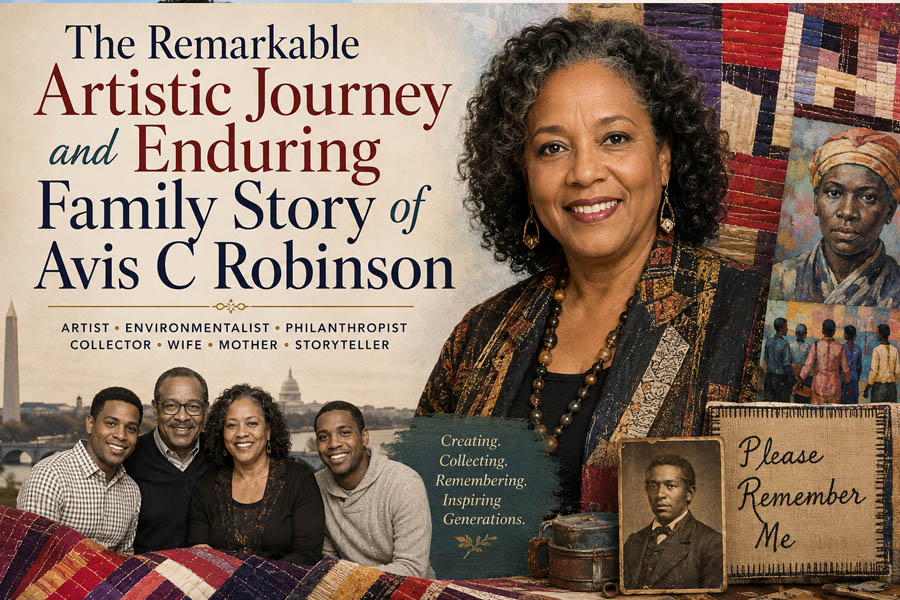
Avis C Robinson lived several lives within one remarkable lifetime. I find that fact especially compelling because her story does not fit neatly into a single box. She was an environmental policy leader, philanthropist, collector, wife, mother, daughter, and eventually a celebrated visual artist whose paintings and quilts transformed memory into something almost tangible.
Born on July 26, 1953, in Baltimore, Maryland, Avis grew up in Montgomery County, including the Silver Spring area, in a family where creativity and intellectual curiosity were already intertwined. Her mother, Annie Ruth Collins, was both a painter and a cancer researcher, an unusual combination that left a lasting imprint on her daughter. Avis inherited more than artistic ability. She inherited a fascination with memory, history, evidence, and the stories hidden inside ordinary objects.
That fascination would eventually become the heartbeat of her art.
Early Life Education and Family Roots
Avis was the daughter of Annie Ruth (née Brown) Collins and Edward Rhodes Collins. Her genealogy includes African, European, and Nottoway Indian origins, and these connected histories were increasingly crucial to her understanding of identity.
She graduated from the Academy of the Holy Cross in 1971 and received a bachelor’s degree from the University of Maryland in 1974, where she studied economics and urban studies. Later, she pursued academic degrees, including studies at Golden Gate University and a Master of Public Administration from Harvard University in 1988.
I believe it is significant that her early academic career was not especially creative. Economics, urban studies, public administration, environmental policy, education, and art may appear to be different highways on a map, but in Avis’s life, they eventually came together around one core question: how do individuals construct the world they inherit?
Her mother was particularly relevant to the subject. Annie Ruth’s creative practice provided Avis with an early introduction to painting, while her scientific work presented a another way of looking at the world. After her mother died, Avis became profoundly committed to remembering her family and preserving tales that may otherwise be lost.
One of her quilts featured a piece from her mother’s nightgown. It was an intimate gesture, similar to weaving a family photo into fabric.
Marriage to Eugene Robinson
Avis’s personal life was closely connected to the career of her husband, Eugene Harold Robinson, the prominent journalist and Washington Post columnist.
Eugene Robinson was born on March 12, 1954, in Orangeburg, South Carolina. Over the course of his career, he became a longtime Washington Post columnist and associate editor, an NBC News and MSNBC political analyst, and an author. He won the Pulitzer Prize for Commentary in 2009.
Avis and Eugene met in the late 1970s, with accounts placing their meeting in connection with San Francisco and University of Maryland circles. At the time, Eugene was working at the San Francisco Chronicle while Avis was completing postgraduate work.
They married around September 23, 1978.
Their marriage lasted approximately 45 years, making their partnership one of the enduring foundations of Avis’s life. They shared interests in social justice, history, African American culture, education, and collecting. Their relationship also became a creative partnership.
Together, they built the remarkable “Please Remember” collection of African American historical artifacts. At one point, the collection contained nearly 3,000 objects and documents, representing everything from slavery-era material to objects associated with the civil rights movement.
For Avis, collecting was never simply about possession. It was about rescue. Objects could carry voices, and forgotten objects could sometimes tell stories that official histories had overlooked.
Avis C Robinson as a Wife and Mother
Avis and Eugene had two sons, Aaron and Lowell Robinson.
The family largely maintained a private life despite Eugene’s public career. Aaron and Lowell have generally stayed away from the spotlight, allowing their mother’s artistic and professional achievements to speak without turning the family into a celebrity spectacle.
Avis was also a grandmother to Alice and Malcolm. Her surviving family included her daughter-in-law Maureen, her sister Kirsten, foster brothers Harold and Donald Miles, and extended nieces and nephews.
The family structure surrounding Avis helps explain why memory became such a recurring theme in her work. She did not treat history as something locked in a museum case. She treated it as something passed from parent to child, from grandmother to grandchild, and from one generation to another.
Her husband later described her publicly in deeply affectionate terms, remembering her as the love of his life. After her death, Eugene also wrote about the projects she left unfinished, giving the public a glimpse into the determination that characterized her final months.
More Than Two Decades in Environmental Policy
Before Avis became widely recognized as an artist, she spent more than two decades working for the U.S. Environmental Protection Agency.
Her career eventually took her to the position of Deputy Director of the Office of Atmospheric Programs. She worked on early climate change initiatives and coordinated with governments in Asia and sub-Saharan Africa.
Environmental justice was also part of the larger philosophy behind her work. She understood that environmental problems rarely affect everyone equally. Communities with fewer resources can carry some of the heaviest burdens.
Around 2003, after more than 20 years at the EPA, Avis left government service.
It was not the end of her public life. It was simply the turning of another page.
Building Washington Metropolitan Scholars
After leaving the EPA, Avis shifted much of her attention toward education and philanthropy.
She founded and became President and CEO of Washington Metropolitan Scholars, a nonprofit designed to help high-achieving, low-income minority students in the Washington, D.C., metropolitan area gain access to higher education.
The organization connected students with roughly 50 leading universities and focused not simply on getting young people into college, but on helping them succeed once they arrived.
This phase of Avis’s career reflected the same values that had shaped her environmental work. She was interested in systems, opportunity, and the question of who gets a chance to build a different future.
Her professional journey therefore moved from environmental policy to educational access and eventually to visual art, but the underlying thread remained remarkably consistent: she wanted people and communities to have the resources to tell their own stories.
The Artistic Transformation of Avis Robinson
By the late 2000s, art increasingly became the center of Avis’s life.
She had painted earlier and had been quilting since her twenties, but around 2008 she began devoting much more of her energy to visual art. Her practice eventually included oil and acrylic painting, mixed media, fabric work, and especially quilts.
Her work was rarely quiet.
Colors collided. Fabrics carried memories. Portraits emerged from layers. Historical figures appeared alongside anonymous people whose courage had never received a headline.
She painted figures such as Harriet Tubman, John Lewis, Jimi Hendrix, Abraham Lincoln, and Vivian Malone. Yet she was equally interested in ordinary African American life, family history, oppression, resilience, and the complicated emotional landscape of race and identity.
Her art often felt like a conversation between painting and quilting.
The Powerful Influence of Gee’s Bend
Gee’s Bend, a historically African American hamlet in Alabama that is now officially known as Boykin, had a significant impact on Avis’ textile art.
Gee’s Bend established a particular quilting tradition influenced by necessity, creativity, family, and solitude. Women made quilts out of whatever materials were available, such as used garments, denim, corduroy, grain sacks, and household linens.
The outcomes were frequently wildly improvised.
Instead of rigorous symmetry, Gee’s Bend quilters were able to construct shifting strips, asymmetrical blocks, uneven borders, unexpected color combinations, and dynamic geometric structures. The quilts could appear both utilitarian and strikingly new.
Avis discovered something profound in that language.
She had a close association with the Gee’s Bend quilters, as seen by her work Sharecropper’s Masterpiece, published in 2008. Avis pieced the quilt top herself, using the Gee’s Bend quilt pattern. The composition consisted of nine asymmetrical blocks organized in a three-by-three grid, with corduroy and velvet strips in reds, pinks, purples, and white.
Mensie Lee Pettway and Andrea Pettway Williams, both from the Gee’s Bend quilting community, finished the quilting.
That partnership is significant because it demonstrates that Avis was not simply copying a visual style from elsewhere. She was participating in a live tradition by allowing its creators to become part of the work itself.
Avis gained an improvisational vocabulary from Gee’s Bend, which she then transformed into her own artistic language. She utilized bold geometry, painting, important fabrics, historical connections, and personal memory.
The end result was neither simple painting nor typical quilting.
It was Avis Robinson.
The Please Remember Collection
Avis and Eugene’s collecting practice was another major part of her creative identity.
Their “Please Remember” collection reflected an understanding that history lives inside objects. A document, garment, photograph, tool, or household item can become a kind of witness.
The collection eventually grew to thousands of African American artifacts. Some objects were later auctioned, while portions entered institutional collections, including the Smithsonian National Museum of African American History and Culture.
The title “Please Remember” perfectly captures Avis’s philosophy.
She was asking viewers not to look away.
Major Artistic Recognition
Avis’s reputation grew steadily during the 2010s and early 2020s.
Her work appeared in exhibitions and embassy collections, including projects connected with the Foundation for Art and Preservation in Embassies. Her art reached U.S. diplomatic spaces in places including New York, London, and Moscow.
In 2022, her exhibition “Black Hands Moving Colors” at the Columbus Museum of Art brought further attention to her distinctive combination of fabric, abstraction, history, and African American experience.
In 2023, she received a commission connected with the U.S. Embassy in Hanoi, Vietnam, involving eight quilts.
She was also creating “Sewing the Seasons” for The Washington Post, an ambitious project structured around the four seasons. Spring, Summer, and Autumn were completed with accompanying essays.
Winter was different.
She designed it as a painting but became too ill to finish the fabric version.
Her Final Months and Death
Avis was diagnosed with cancer in 2023 and experienced a sudden, brief illness.
Even while seriously ill, she remained focused on her creative work. One especially poignant detail is that she requested a sewing machine while in the hospital intensive care unit.
That image stays with me because it says so much without needing a long explanation. Her body was failing, but her imagination was still moving.
Avis Collins Robinson died on October 28, 2023, at the age of 70.
Her funeral was held on November 11, 2023, at St. John the Baptist Catholic Church in Silver Spring, Maryland.
Her death left Eugene, their sons Aaron and Lowell, grandchildren Alice and Malcolm, and a wide network of relatives, friends, students, artists, and admirers to carry forward the memories she had spent so much of her life preserving.
Her Legacy Through Fabric Paint and Memory
Avis’ legacy remained after her death.
In 2025, “From Fabric to Paint: Funk, Soul, and the Art of Avis Robinson” will be shown at IA&A Hillyer. The show focused on her paintings and textiles while also providing visitors with more information about her life and creative process.
The title itself describes the interesting arc of her artistic path. The fabric became paint. Paint became memory. Memories become history.
Her career also displays how seemingly unrelated experiences can complement one another. The environmental policymaker understood systems. The benefactor recognized opportunity. The collector grasped historical evidence. The daughter understood recollection. The mother understood inheritance. The artist recognized how all of these concepts may be linked together.
Avis C Robinson Family at a Glance
| Family member | Relationship to Avis C Robinson |
|---|---|
| Annie Ruth Collins | Mother, painter and cancer researcher |
| Edward Rhodes Collins | Father |
| Kirsten | Sister |
| Eugene Harold Robinson | Husband of approximately 45 years |
| Aaron Robinson | Son |
| Lowell Robinson | Son |
| Maureen | Daughter-in-law |
| Alice | Granddaughter |
| Malcolm | Grandson |
| Harold Miles | Foster brother |
| Donald Miles | Foster brother |
FAQ
Who was Avis C Robinson?
Avis C Robinson was an American artist, environmentalist, philanthropist, collector, and advocate whose later career became especially known for mixed-media paintings and quilts exploring African American history, identity, race, memory, and resilience.
When was Avis C Robinson born?
Avis C Robinson was born on July 26, 1953, in Baltimore, Maryland, and grew up primarily in Montgomery County, Maryland.
Who was Avis C Robinson’s husband?
Avis was married to journalist Eugene Harold Robinson for approximately 45 years. Eugene became a Pulitzer Prize winning Washington Post columnist, author, and television political analyst.
How many children did Avis C Robinson have?
Avis and Eugene Robinson had two sons, Aaron and Lowell. The family generally maintained a private life despite Eugene’s prominent public career.
What was Avis Robinson’s connection to Gee’s Bend quilting?
Avis was strongly influenced by the improvisational geometry and material traditions of Gee’s Bend quilting and worked directly with Gee’s Bend quilters. Her 2008 quilt Sharecropper’s Masterpiece is a particularly clear example of that connection.
What was the Please Remember collection?
The “Please Remember” collection was the extensive African American historical collection assembled by Avis and Eugene Robinson. It grew to nearly 3,000 artifacts and documents representing different periods of African American history.
What did Avis Robinson do before becoming an artist?
Before concentrating on art, Avis spent more than 20 years with the U.S. Environmental Protection Agency, eventually serving as Deputy Director of the Office of Atmospheric Programs. She later founded and led Washington Metropolitan Scholars.
When did Avis C Robinson die?
Avis C Robinson died on October 28, 2023, at age 70, following a sudden and brief battle with cancer.
What happened to her unfinished artistic work?
Avis left several projects unfinished when she died, including the Winter component of her “Sewing the Seasons” project. Her husband Eugene Robinson later wrote about the unfinished work and its significance.