A Young Man Growing Up in the Shadow of a Legend
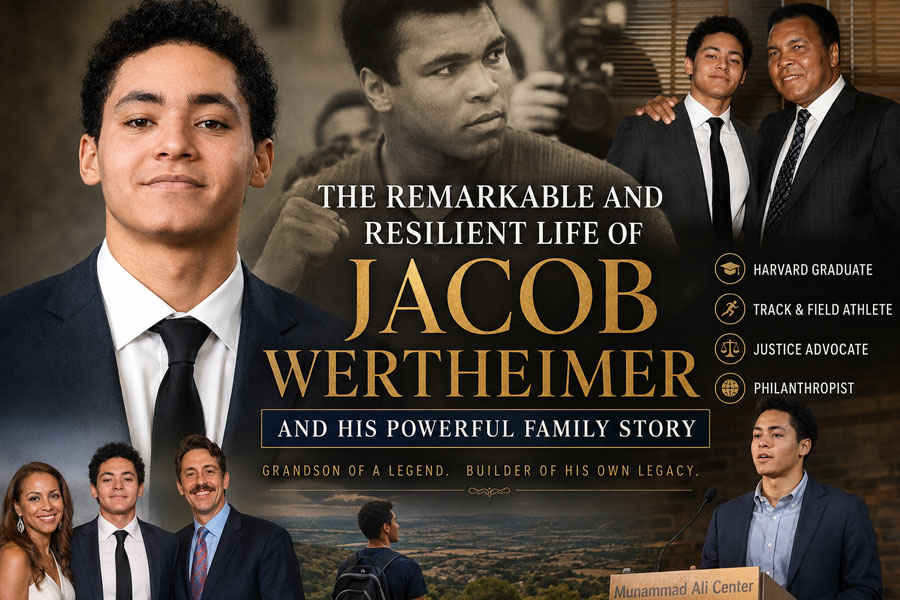
When I look at the life of Jacob Wertheimer, I see a story shaped by an extraordinary inheritance, but not one defined by celebrity. Born on January 21, 1999, Jacob grew up carrying the name of one of the most recognizable figures of the twentieth century. His maternal grandfather was Muhammad Ali, the three time heavyweight champion whose influence reached far beyond boxing. Yet Jacob has largely chosen a quieter road.
Jacob was raised in the Philadelphia area, associated with the Main Line and the community around Haverford. His parents, Khaliah Ali and Spencer Wertheimer, gave him a family environment that combined athletics, law, philanthropy, culture, and public service. His mother is one of Muhammad Ali’s daughters and has developed her own career as a designer, humanitarian, author, and advocate. His father, Spencer, is a Philadelphia attorney with experience in intellectual property, personal injury, entertainment matters, and the arts.
That combination seems important when I consider Jacob’s development. He did not simply grow up surrounded by fame. He grew up around people who worked. His family connections opened doors, but his own interests gradually pointed toward education, athletics, justice, and community service.
One of the most revealing moments of his youth came in 2012. At the age of 13, Jacob chose to become a bar mitzvah at Congregation Rodeph Shalom in Philadelphia. The ceremony emphasized inclusiveness and diversity, and Muhammad Ali attended. The decision was particularly meaningful because Khaliah had been raised in a Muslim environment. Rather than presenting identity as a dividing line, Jacob’s family treated the occasion as an opportunity to celebrate understanding and connection.
I find that moment especially striking because it reflects a theme that appears repeatedly in Jacob’s story: different traditions can coexist without canceling each other out.
The Family Behind Jacob Wertheimer
Jacob’s family tree is unusually rich, complicated, and historically significant. His maternal grandfather, Muhammad Ali, was born Cassius Marcellus Clay Jr. in 1942 and became a global symbol of athletic excellence, racial dignity, religious conviction, and political courage. Ali’s decision to oppose the Vietnam War and his willingness to accept professional consequences for his principles became central to his public identity.
For Jacob, however, Muhammad Ali was not simply an icon hanging on the walls of history. He was his grandfather.
Jacob has spoken about Ali’s activism and the importance of standing by one’s principles. In 2016, when Ali was nearing the end of his life in Arizona, Jacob spent extended time at his bedside. That experience gave the family legacy a deeply personal dimension. The champion who had once filled stadiums with his voice had become an aging grandfather surrounded by family.
Jacob’s mother, Khaliah Ali, has also played a major role in his life. She has built a career that reaches across fashion, humanitarian work, philanthropy, and advocacy. Through the Khaliah Ali Collection, she became known in the fashion and retail world, while her charitable activities have addressed issues ranging from missing and exploited children to health disparities and human rights.
Her relationship with Jacob appears especially close. They have worked together on philanthropic initiatives and have participated in events connected with Muhammad Ali’s legacy. Khaliah has often portrayed her son with obvious affection, and Jacob has become a trusted partner in causes that matter deeply to her.
His father, Spencer Miles Wertheimer, brought another professional tradition into the family. Spencer is a Philadelphia lawyer and has also been connected with acting, athletics, and the arts. He has a son named Josh from an earlier marriage, giving Jacob a blended family connection outside his mother’s side.
The family became even larger through Khaliah’s marriage to music executive and criminal justice advocate Jason Flom on October 6, 2024. Khaliah and Flom had developed a relationship partly through their shared interest in criminal justice reform, with Jacob serving as an important connection between them. Flom has two children, Allison and Mike, from a previous marriage.
Harvard, Athletics, and a Different Kind of Ambition
Jacob’s academic path is one of the clearest indications that he wanted to build an identity of his own.
He graduated from Harvard University in May 2021 with a Bachelor of Arts degree in Government and African and African American Studies. He was associated with Adams House and competed in Harvard track and field.
Athletics had already been part of his life before college. At Haverford High School, Jacob competed in track and field, particularly throwing events, while also participating in basketball and running. He was known as a strong student and had shown interest in the decathlon and multi event competition.
At Harvard, his athletic work included events such as javelin and shot put. His javelin performances reached roughly 49 meters, giving him a competitive identity separate from the famous surname attached to him.
I think that detail matters. It is easy to imagine someone born into the Muhammad Ali family being pulled toward entertainment, boxing, or celebrity. Jacob instead combined athletics with government and African American studies. His academic choices suggest an interest in institutions, history, race, public policy, and social change.
That combination also helps explain his later involvement with criminal justice and youth advocacy.
Malaika and a Connection to the Congo
Jacob’s work with Malaika, a nonprofit formed by Noëlla Coursaris Musunka in the Democratic Republic of the Congo, is a pivotal element of his journey.
Malaika works in Kalebuka, near Lubumbashi, with a focus on educating girls and building the local community. Its programs go beyond education to cover clean water, health, agriculture, vocational training, sports, literacy, technology, and entrepreneurship.
Jacob’s involvement with the group began while he was young. Around 2009, he and his mother helped lay the first brick for the school project. Years later, he got more formally active as a Youth Ambassador, while Khaliah served as Goodwill Ambassador.
The connection has historical significance because Muhammad Ali fought George Foreman in the legendary 1974 “Rumble in the Jungle” in Zaire, which is now the Democratic Republic of the Congo. More than three decades later, Jacob’s involvement established a new type of connection to the country, one focused on education and opportunity rather than sports.
Malaika’s school has grown from an initial class of 104 students in 2011 to hundreds of girls. Its educational model incorporates STEM disciplines, coding, English and French, health education, arts, athletics, leadership, and civic involvement. Students get school supplies, clothing, medical exams, and food.
The group also runs community projects that promote clean water wells, farming, vocational education, football, literacy, and entrepreneurship.
For me, this section of Jacob’s history indicates something significant about the Ali legacy. Muhammad Ali rose to prominence after participating in a boxing match. Jacob appears to be more interested in having challenging conversations and supporting organisations that allow young people to shape their own futures.
Justice, Equality, and the Ali Legacy
Jacob has also developed interests in criminal justice reform and racial equality. His involvement with the Juvenile Law Center in Philadelphia reflects a particular concern for young people and the justice system.
He has participated in discussions surrounding protests and racial justice and has reflected on the historical activism of his grandfather. The connection between generations is especially visible when Jacob discusses Muhammad Ali’s willingness to sacrifice career opportunities because he believed certain principles were more important than personal success.
Jacob’s perspective is not simply about preserving an old family story. He appears interested in translating that story into contemporary issues.
The same spirit can be seen in his interest in interfaith events, the Muhammad Ali Center, and programs dealing with equality and community engagement. His public appearances remain relatively limited, but when he does speak, the subjects tend to be larger than himself.
The Wider Ali Family
Jacob belongs to an exceptionally large blended family. Muhammad Ali had several children from different relationships, creating a network of half siblings, cousins, and extended relatives.
Among his maternal half aunts are Maryum Ali, Jamillah Ali, Rasheda Ali, Miya Ali, Hana Ali, and Laila Ali. Laila became a professional boxer herself and established an athletic reputation that was unmistakably her own.
Jacob’s maternal half uncles include Muhammad Ali Jr. and Asaad, Muhammad Ali’s adopted son. The next generation includes figures such as Nico Ali Walsh and Biaggio Ali Walsh, who have continued to attract attention through boxing and athletics, as well as members of Laila Ali’s family.
This enormous family circle means Jacob’s upbringing was surrounded by stories of sport, activism, entertainment, religion, business, and public service. Yet he has generally avoided turning his family name into a constant media performance.
A Private Life With a Public Purpose
There is surprisingly little reliable public information about Jacob’s romantic life, personal finances, salary, or private day to day activities. His net worth has not been established publicly, and he does not appear to pursue the kind of celebrity lifestyle associated with many famous family members.
That privacy seems deliberate.
Jacob’s public identity is built primarily around education, advocacy, athletics, philanthropy, and the legacy of Muhammad Ali. His social media presence is not centered on self promotion. Instead, he tends to appear through family posts, organizational activities, commemorations, and philanthropic events.
His relationship with his mother remains one of the strongest visible elements of his public life. Together they have appeared at events connected with Malaika, Muhammad Ali commemorations, criminal justice initiatives, interfaith programs, and humanitarian causes.
In a family where almost every generation has produced someone recognizable to the public, Jacob’s quietness becomes part of his character. He seems less interested in standing beneath the spotlight than in deciding what to do with the light that was handed to him.
Jacob Wertheimer’s Continuing Family Legacy
Jacob Wertheimer’s tale is constantly growing. At 27 years old in 2026, he already has a unique set of experiences: a Harvard education, collegiate athletics, international philanthropy, involvement in criminal justice advocacy, and an intimate friendship with one of America’s most influential cultural leaders.
What interests me the most is how he appears to approach inheritance. Muhammad Ali left him a famous surname and an exceptional family history, but Jacob does not appear to be content with preserving images and memories.
His work with Malaika connects him with Congolese females seeking an education. His interest in justice connects him to young people who are navigating challenging judicial systems. His intellectual background relates him to issues concerning government and race. His family background links him to one of the most complex and powerful families in modern sports history.
As a result, the novel feels less like a biography of a celebrity descendent and more like the early chapters of a person deciding what legacy means after the legacy has already been enormous.
Frequently Asked Questions
Who is Jacob Wertheimer?
Jacob Wertheimer is the son of Khaliah Ali and attorney Spencer Wertheimer and the maternal grandson of Muhammad Ali. Born January 21, 1999, he is a Harvard graduate, former track and field athlete, philanthropist, and advocate associated with social justice and criminal justice issues.
What did Jacob Wertheimer study at Harvard?
Jacob graduated from Harvard University in May 2021 with a Bachelor of Arts in Government and African and African American Studies. He was also a member of Harvard’s track and field program.
Is Jacob Wertheimer related to Muhammad Ali?
Yes. Muhammad Ali was Jacob’s maternal grandfather. Jacob was especially close to Ali and spent time with him during the final period of Ali’s life in 2016.
Who is Jacob Wertheimer’s mother?
His mother is Khaliah Ali, one of Muhammad Ali’s daughters. Khaliah is a designer, author, philanthropist, humanitarian, and advocate who has worked on numerous social and charitable causes.
Who is Jacob Wertheimer’s father?
His father is Spencer Miles Wertheimer, a Philadelphia attorney whose professional work includes intellectual property, personal injury, entertainment matters, and related civil law.
What is Jacob Wertheimer’s connection to Malaika?
Jacob became involved with Malaika, a nonprofit working in the Democratic Republic of the Congo, when he was young. He participated in an early school project and later served as a Youth Ambassador. His mother, Khaliah Ali, has also been involved with the organization as a Goodwill Ambassador.
What does Malaika do?
Malaika supports girls’ education and community development in Kalebuka in the Democratic Republic of the Congo. Its programs include schooling, clean water, health education, agriculture, sports, vocational training, technology, literacy, and entrepreneurship.
Did Jacob Wertheimer play sports?
Yes. Jacob competed in track and field at Haverford High School and Harvard University. His events included throwing disciplines such as javelin and shot put, and he also participated in other sports during his school years.
Was Jacob Wertheimer close to Muhammad Ali?
Public accounts indicate that Jacob shared a close relationship with his grandfather. He was present with Ali during his final hours in Arizona in 2016 and has reflected on Ali’s activism, racial justice work, and willingness to stand by his convictions.
Is Jacob Wertheimer a professional boxer?
No. Although he comes from the family of Muhammad Ali and other prominent athletes, Jacob has not established a professional boxing career. His athletic background has primarily involved track and field.
What is known about Jacob Wertheimer’s career?
Public information about his post Harvard career is limited. His visible interests have included criminal justice, youth advocacy, philanthropy, racial justice, and Muhammad Ali’s legacy rather than a highly public commercial career.
Who is Jacob Wertheimer’s stepfather?
Khaliah Ali married music executive and criminal justice advocate Jason Flom on October 6, 2024. Flom became Jacob’s stepfather through that marriage and has two children, Allison and Mike, from a previous marriage.
Where does Jacob Wertheimer live?
Detailed current information about Jacob’s private residence and daily life is not broadly public. His upbringing is associated with the Philadelphia area, particularly the Main Line and Haverford community.
What makes Jacob Wertheimer’s story distinctive?
For me, Jacob’s story stands out because he has inherited one of the most recognizable names in sports history while choosing a relatively private path. His education, athletics, philanthropy, and interest in justice suggest that he is building his own interpretation of the Ali legacy rather than simply living inside it.