A man who moved through history like a match across dry grass
I think of Peter Rodd as one of those figures who never stayed still long enough to become simple. He was born into privilege, carried a famous family name, married into literary legend, and still seemed to slip through every fixed identity people tried to give him. He was Peter Murray Rennell Rodd, born on 16 April 1904 in London, and his life had the sharp outlines of an old portrait, with a restless, shifting light. He was soldier, aid worker, banker at one point, political flirt, failed filmmaker, husband, and member of a large and imposing family. Each role caught only part of him.
The name Peter Rodd is often remembered through his marriage to Nancy Mitford, but the family story is wider than that. He was born into a household where public duty, status, and ambition sat at the table every day. That kind of upbringing can produce polish, but it can also produce friction, like stones rubbing in a riverbed. Peter seems to have been shaped by both.
His parents, grandparents, and the family house he came from
Peter Rodd was the son of James Rennell Rodd and Lilias Georgina Guthrie. His father, James Rennell Rodd, later became 1st Baron Rennell, and he was a diplomat, poet, and politician. That alone tells you something about the atmosphere Peter grew up in. This was a family where conversation likely moved easily from public affairs to literature to empire. His father was not a minor figure on the margins. He was a man with rank, reputation, and a life lived in the service of the state.
His mother, Lilias Georgina Guthrie, came from a distinguished line as well. She was the fourth daughter of James Alexander Guthrie, 4th Baron of Craigie, and Elinor Stirling. So Peter did not come from one of those families that had to invent importance. It was already built into the structure of the name. He inherited a world of titles, expectations, and inherited connections, the kind of world where even the furniture seems to know its place.
His paternal grandparents were Major James Rennell Rodd and Elizabeth Anne Thomson. His maternal grandparents were James Alexander Guthrie and Elinor Stirling. In other words, Peter stood at the crossing point of two established families, one carrying the Rodd line and one carrying the Guthrie line. The family tree was not a thin branch. It was a broad canopy.
Brothers and sisters, each with a distinct path
Peter was one of six children; one died in infancy. Christopher John Rodd, Francis James Rennell Rodd, Evelyn Violet Elizabeth, Gloria Elinor, and Hon. Gustaf Guthrie Rodd were his siblings. Each child in this family had to fit into a solid outline.
Christopher John Rodd died young, leaving behind his family name. Francis James Rennell Rodd, 2nd Baron Rennell, shaped geography and learned societies. He appears to have handled official responsibilities better than Peter. As Baroness Emmet of Amberley, Evelyn Violet Elizabeth Rodd entered politics. Gloria Elinor Rodd married Simon Elwes, bringing the family into art. Gustaf Guthrie Rennell Rodd married Yvonne Mary Marling, expanding the family.
In contrast, Peter feels like the skewed sibling. He wasn’t the heir, politician, public scholar, or family anchor. His drift was greater. That doesn’t diminish his appeal. The one who rejects the familial pattern sometimes shows it best.
Marriage to Nancy Mitford, and the strange weather of that relationship
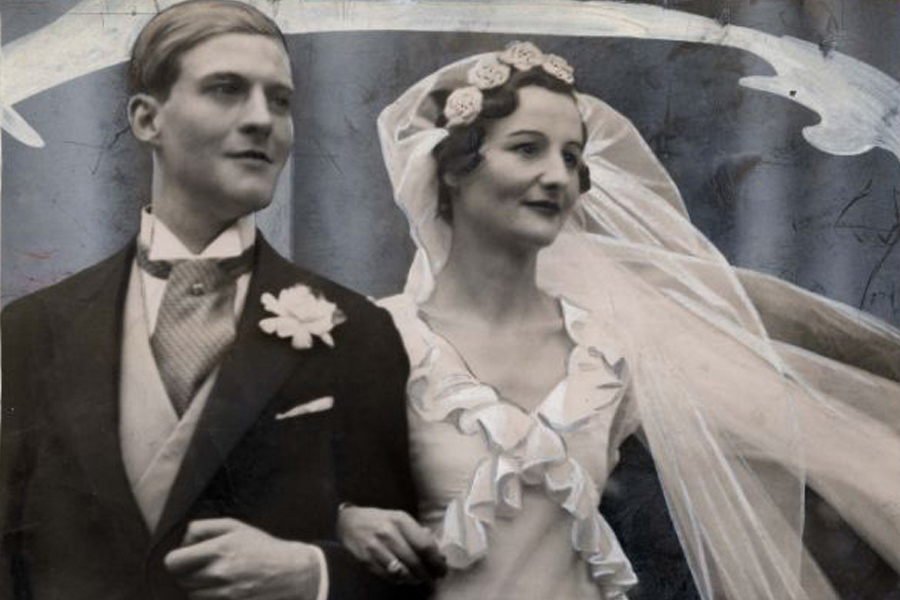
Peter Rodd married Nancy Freeman-Mitford, better known as Nancy Mitford, on 4 December 1933 in London. This marriage placed him inside one of the most discussed literary families of the 20th century. Nancy was the eldest of the Mitford sisters, a novelist with a fierce eye and a dry brilliance. She had style, wit, and a very specific kind of social fire. Peter had charm and pedigree, but the match was not warm for long.
They had no children. That fact matters, because it means the marriage did not produce a next generation to blur its edges. It remained what it was, a union of two strong personalities that gradually broke apart. The marriage was unhappy, and the distance between them widened over time. Some marriages are a bridge. This one was more like two banks of a river, close enough to see each other, far enough to remain separate.
Peter and Nancy divorced in the late 1950s, with the exact date appearing differently in different accounts, but the broad truth is clear: the marriage did not last. Still, it remains one of the most important parts of his biography because it joined him to a literary dynasty that still fascinates readers.
Career, work, and the oddness of achievement
Peter Rodd did not leave behind a neat career ladder. He is described as having worked as a banker around the time of his marriage, but he did not build a long, stable identity in finance. He also joined the British Union of Fascists in 1933, though he later turned against it. That detail marks the turbulence of the era and the volatility of some of his choices. He seems to have been a man who moved quickly through ideas, sometimes before they had settled.
In 1938, he worked in Perpignan helping refugees from the Spanish Civil War. That is one of the more humane and grounded acts in his life. The refugee crisis cast long shadows across Europe, and Peter stepped into that moment with practical help. In 1939, he was commissioned into the Welsh Guards. During the war, he served in Africa and Italy, and he rose to the rank of lieutenant-colonel. That is a real military record, not a decorative one.
After the war, he tried his hand at film-making, but the project failed. The title often associated with it, For Whom the Gate Tolls, has the feel of a grand ambition that could not quite hold its own weight. That seems fitting for Peter. He was a man of attempts, not just results. Some of his life reads like a series of doors opened, then half-closed.
Finances, later life, and the softer ruin of decline
His finances seem precarious. Public records do not reveal a tidy fortune or disciplined financial career. Peter lives in Rome and Malta and sometimes needs help in his later years. The detail lends his story a weathered feel. Men born near the center of status can nonetheless be marginalized.
On July 17, 1968, he died in Malta. The dazzling social world of his youth was gone, and the family name was more history than opportunity. He was intriguing because he linked nobility, literature, war, politics, and marriage instability.
Why Peter Rodd still holds attention
I think Peter Rodd endures because he is not easy to reduce. He was not a pure success story, not a total failure, not a simple villain, not a saint. He was a man shaped by inherited privilege and personal restlessness, by wartime service and social instability, by a famous wife and an even more famous family network. He is remembered partly because of the people around him, but also because his own life has the kind of uneven contour that makes history feel human. He was not a straight line. He was a weather front.
FAQ
Who was Peter Rodd?
Peter Rodd was a British soldier, aid worker, former banker, and the husband of novelist Nancy Mitford. He was born in 1904 and died in 1968.
Who were Peter Rodd’s parents?
His parents were James Rennell Rodd and Lilias Georgina Guthrie. His father later became 1st Baron Rennell.
Who were Peter Rodd’s grandparents?
His paternal grandparents were Major James Rennell Rodd and Elizabeth Anne Thomson. His maternal grandparents were James Alexander Guthrie and Elinor Stirling.
Did Peter Rodd have children?
No, Peter Rodd and Nancy Mitford did not have children.
What were Peter Rodd’s main achievements?
His main achievements were military service, especially during the Second World War, and earlier humanitarian work helping refugees in Perpignan during the Spanish Civil War.
What is Peter Rodd most known for today?
He is most often remembered as Nancy Mitford’s husband and as a member of the prominent Rodd family, especially through his connections to British aristocracy, diplomacy, and wartime service.